agentic-data-analyst
Chat with your data: Claude writes read-only DuckDB SQL, a second agent reviews it, and deterministic guardrails and cost budgets bound every query — answers, tables and charts in Chainlit.


Public case studies
Six open-source repositories and one live AI research lab—inspectable evidence of how I approach data engineering, machine learning, delivery and operations.
Open-source repositories
Focused libraries drawn from recurring client problems—guarded analytics agents, data quality, experimentation and automotive measurement data—alongside the engine and template behind Retro Speedlab.
Chat with your data: Claude writes read-only DuckDB SQL, a second agent reviews it, and deterministic guardrails and cost budgets bound every query — answers, tables and charts in Chainlit.
Typed, Spark-native data-quality validation and profiling that combines compatible checks into a single aggregation pass.
A typed library for A/B experiments covering inference, sample-ratio-mismatch diagnostics, power analysis and multiple-testing correction.
An Apache Spark DataSource V2 connector for distributed analysis of ASAM MDF4 vehicle measurement data, with filter pushdown into the file.
The engine behind the lab: Go-Explore and tree search over emulator save states, guided by a PPO policy and a route map read from a TAS video, with every run verified frame-exact from power-on.
A Cookiecutter template for game packages: a skeleton that knows nothing about its game until scheduled Claude Code lab runs grow it.
Why it exists
Much of my commercial work sits inside client environments and is protected by non-disclosure agreements. Retro Speedlab offers a modest, transparent alternative: a real system that can be inspected, used and challenged in public.
The lab asks a focused question: how fast can an AI finish Snake Rattle 'n Roll, warpless, from power-on? Answering it combines two disciplines that organisations increasingly need together. The engine searches over emulator save states in parallel emulators, guided by a PPO policy that learns which buttons work and by a route map read from a reference tool-assisted-speedrun video. A new part of the run counts only once it replays frame-exact from power-on, all on a 2017 desktop with an RTX 2070. When the search gets stuck, a scheduled team of Claude Code agents improves the game package, and a second Claude agent keeps the platform itself running.
The playful subject keeps the experiment approachable; the engineering behind it is the same I apply to client systems.
Everything happens in public: the run streams live on Twitch, and every lab report and every record is published on the lab's website.
It is not intended to stand in for the scale or constraints of an enterprise engagement. It simply makes the working habits visible: narrow the problem, build the whole path, automate repeatable operations, measure what is running and keep ownership of code and data.
Two disciplines, one system
Search and reinforcement learning find the fastest run; agentic engineering keeps improving the system around it. The lab practises both in production, under the constraints clients face: limited hardware, unattended operation and the need to verify every result.
Finding the fastest inputs through a NES game from power-on, on a desktop from 2017.
For clients: Search, learning and strict verification that optimise a measurable outcome on hardware an organisation already owns, with every experiment tracked in Weights & Biases.
Turning Claude into a dependable, unattended engineering process, with evaluation and observability built in.
For clients: Agents that act on real systems within defined boundaries, measured on outcomes, with a trace and an audit trail for every change they make.
Inside the product
The website is fed by the run itself: the live stream, the lab reports and the method behind them. These are live views of the lab rather than presentation mock-ups.
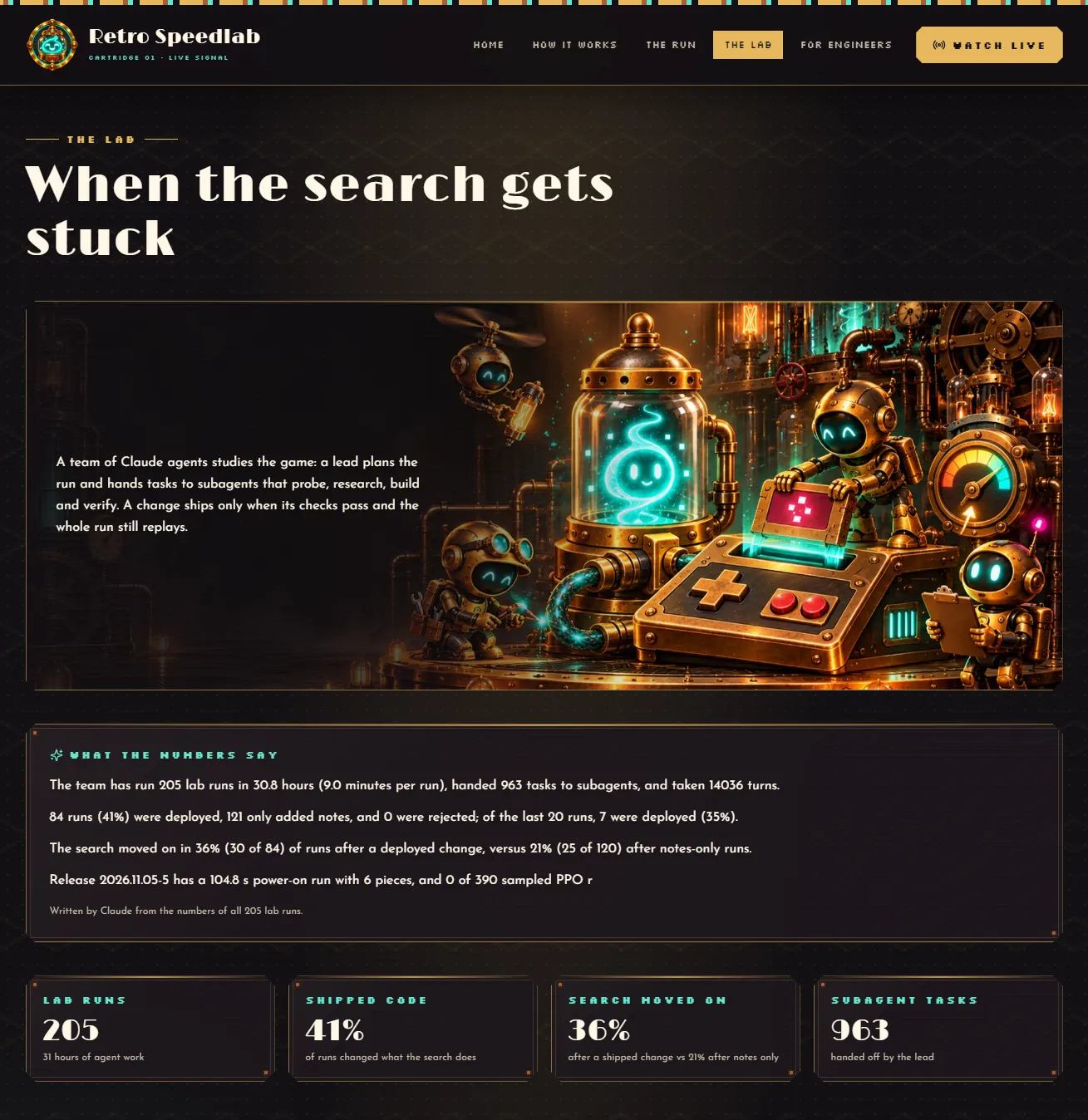
The lab page reports what the Claude agents did: lab runs, shipped changes, subagent tasks and how often the search moved on afterwards.
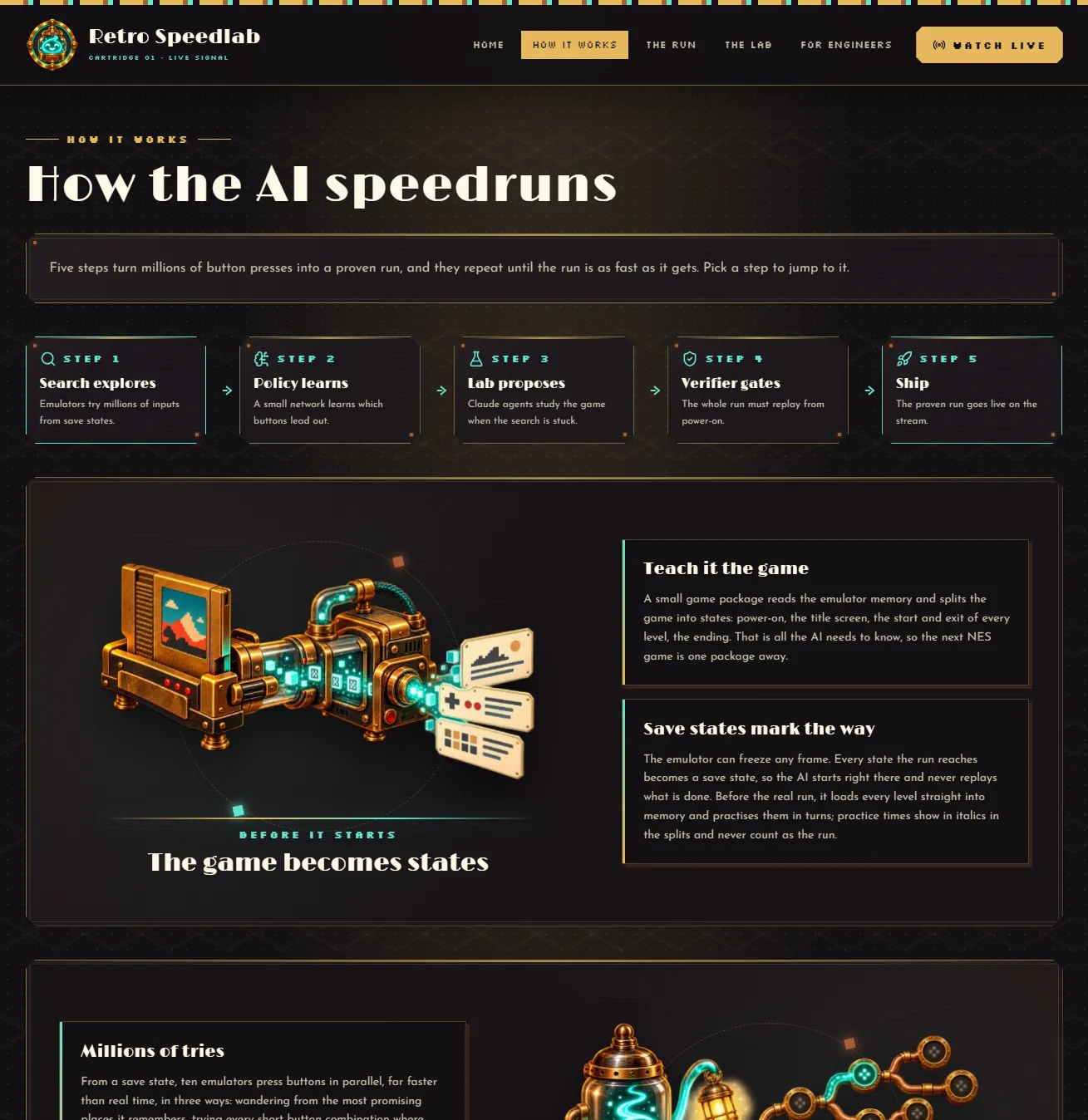
Five steps explain how the search explores, the policy learns, the lab proposes, the verifier gates and the proven run ships.
End-to-end system
Each stage is connected, automated and independently inspectable. Flyte workflows run the speedrun and the lab unattended, on portable, open components rather than unnecessary platform dependency.
What it demonstrates
The value of this case study is not a polished concept deck. It is the connection between a research question, search and learning, autonomous agents and day-to-day operation.
One narrow question, answered in public: how fast an AI finishes a NES game from power-on on a 2017 desktop.
Every release is tracked in Weights & Biases—levels beaten, frames saved, hours since progress—and every lab run is scored on whether the search moved on.
Agents work unattended behind explicit gates: tests must pass, the movie must still replay from power-on, and every run leaves a trace and a report.
A Vue 3 website and stream overlay on FastAPI and PostgreSQL, Twitch chat commands with “Ask the AI”, and a Discord bot that posts records and lab runs.
Docker and Dokku on a Hetzner server and a home server, self-hosted Bugsink and Umami, and ruff and pyright strict in CI.
Claude writes the stream commentary and lab report cards; every input in the run comes from search and a learned policy, proven by replay.
Explore the evidence
The page for engineers lists each component, from the desktop at home to the website, and how well the agents work, measured over every lab run.